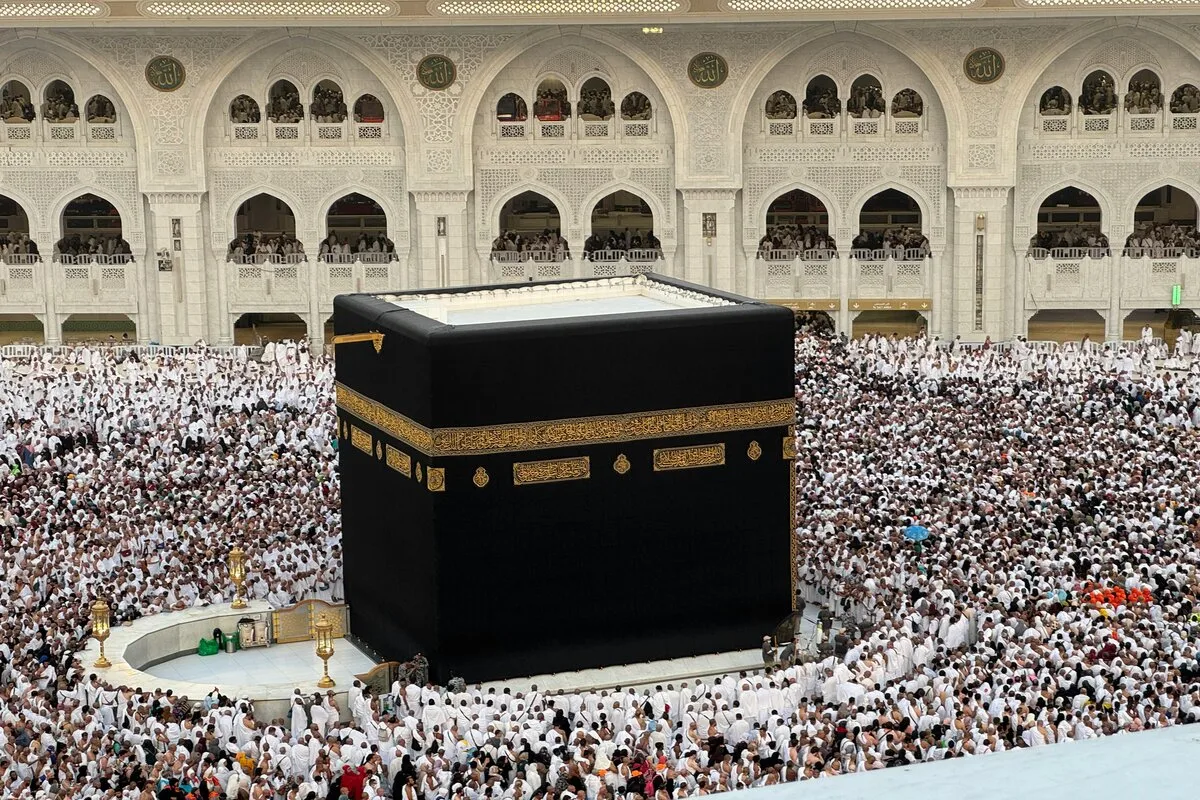


Have you ever paused to truly observe the scene of Tawaf? People from every corner of the world, carrying different customs, cultures, and backgrounds, speaking countless languages, yet all moving in harmony around the Kaaba with the same rhythm, in quiet devotion and focus. It is one of the most powerful images of unity with the universe and human nature, if you take a moment to reflect on it. Ask a pilgrim or someone performing Umrah about how it feels, and they will likely describe a mixture of familiarity, serenity, reverence, and awe, as if, in that moment, nothing else exists in the world but themselves and the Kaaba.
In Islamic teachings, Hajj is the fifth pillar of Islam; an obligation for those who are able to perform it during the first ten days of the month of Dhul-Hijjah. Umrah, on the other hand, is a “Sunnah”; a recommended act of worship according to the majority of Islamic scholars, performed at any time of the year. But both involve a series of specific rituals and acts of devotion that bring the believer closer to God, in hope of His mercy, blessings, and eternal reward.
In this article, we will explore the rituals of Hajj and Umrah, the significance of each pilgrimage, and highlight some of the most important religious sites across Saudi Arabia.
Hajj: The Essential Pillars of a Great Act of Worship
Allah says in the Holy Quran: “And [mention] when We designated for Abraham the site of the House, [saying], ‘Do not associate anything with Me and purify My House for those who perform Tawaf and those who stand [in prayer] and those who bow and prostrate. And proclaim to the people the Hajj; they will come to you on foot and on every lean camel, they will come from every distant pass.’”
The rituals of Hajj are built upon four essential pillars, without which the pilgrimage is not valid. Alongside these pillars are certain obligatory acts that, while not essential for the validity of Hajj, greatly complete its reward and spiritual merit when performed. Each of these pillars and obligations is closely connected to the story of Prophet Ibrahim (Abraham) and the life of Prophet Muhammad (peace be upon him).
Ihram
Ihram is the first pillar of Hajj, and it begins with the intention to perform the pilgrimage, followed by wearing the special garments of Hajj and refraining from certain actions such as cutting nails or shaving hair. The clothing of Ihram symbolizes turning away from worldly luxuries and approaching God with humility and simplicity in search of His pleasure.
The garments themselves are simple and free from adornment. For men, they consist of two clean white unstitched pieces of cloth: one around the waist and covering everything from the navel till the knees, and the other one on the shoulders, while exposing the head and the hands. For women, the attire is modest and loose-fitting, covering the entire body without adornment, with the face and hands left uncovered. In this state, all Muslims stand equal before their Creator, regardless of their background or status.
Standing at Arafat
Mount Arafat holds a profound place in Islamic tradition. It is believed to be the place where Adam and Eve reunited after descending to Earth, and it was also the site where the religion of Islam was completed for the Prophet Muhammad (peace be upon him). Standing at Arafat symbolizes the moment when humanity will stand before God on the Day of Judgment.
This is considered the most important pillar of Hajj, as the Prophet Muhammad (peace be upon him) said: “Hajj is Arafah.” Pilgrims fulfill this pillar by gathering in the plains of Arafat on the ninth day of Dhul-Hijjah, remaining there from the sunset of the 9th day until the sunrise of the 10th, which is the day of Eid. During this time, they devote themselves to supplication, prayer, remembrance, and acts of devotion, seeking forgiveness and mercy from Allah.
Tawaf Al-Ifadah
Tawaf Al-Ifadah represents the honoring of the Sacred House and the renewal of one’s covenant with God. It follows the command given by Allah to Prophet Ibrahim and his son Ismail to purify the House for those who circle it in worship, symbolizing pure monotheism.
This tawaf is called Al-Ifadah because pilgrims return from Mina to Makkah to perform it. It consists of seven circles around the Kaaba, followed by two units of prayer behind the station of Prophet Ibrahim. This ritual takes place after standing at Arafat, the overnight stay in Muzdalifah, the stoning of the pillars, and the sacrifice performed on the Day of Sacrifice.
After completing this tawaf and performing the Sa’i between Safa and Marwah, the pilgrim reaches the stage of major release from Ihram, allowing all previously restricted actions such as cutting hair or trimming nails.
Sa’i Between Safa and Marwah
This pillar is rooted in the story of Hajar (Hagar) and her son Prophet Ismail (Ishmael). When Prophet Ibrahim left them in the barren valley of Makkah by Allah’s command, Hajar ran back and forth between the hills of Safa and Marwah searching for water for her infant child. After her seventh journey, Allah rewarded her perseverance by causing the Zamzam well to spring forth beneath the feet of Ismail; a well that continues to flow to this day by the grace of God.
During this ritual, pilgrims walk between Safa and Marwah for seven rounds, beginning at Safa and ending at Marwah, commemorating Hajar’s determination and faith. One journey from Safa to Marwah counts as one round, and the return counts as another. It must be performed after completing the Tawaf, and supplication during the walk is encouraged. With the completion of this ritual, the rites of Hajj are fulfilled, and the pilgrim is permitted to exit the state of Ihram.
Umrah: A Short Journey with Great Serenity
Umrah also holds immense spiritual rewards; performing one Umrah after another is believed to atone for minor sins committed between them, as the Prophet Muhammad (peace be upon him) said: “Umrah to Umrah is an expiation for the sins committed between them.”
Umrah is the act of visiting the Sacred House of Allah in Makkah at any time of the year to perform specific rituals. It differs from Hajj in several ways, most importantly, Hajj is an obligatory duty for those who are able, while Umrah is a highly recommended Sunnah according to the majority of Islamic scholars. The Prophet Muhammad performed Umrah four times, all in the month of Dhul-Qa‘dah, except for one when he combined Umrah with the Farewell Hajj in Dhul-Hijjah.
The two also differ in their pillars. While Hajj includes several rituals, the pillars of Umrah are limited to Ihram, Tawaf, Sa’i, and shaving or trimming the hair. The steps of Umrah generally proceed as follows: entering the state of Ihram, performing Tawaf around the Kaaba, and then completing Sa’i between Safa and Marwah.
Ihram
As with Hajj, Ihram is the first pillar and begins with making the intention to perform Umrah and wearing the prescribed Ihram garments. During this time, it is recommended to recite the Talbiyah, saying:
“Labbayka Allahumma labbayk, labbayka la sharika laka labbayk. Inna al-hamda wa al-ni‘mata laka wa al-mulk, la sharika lak.” (“Here I am, O Allah, here I am. Here I am, you have no partner, here I am. Truly, all praise, grace, and sovereignty belong to You. You have no partner.”)
Tawaf Around the Kaaba
This pillar is fulfilled by circling the Kaaba seven times in a counterclockwise direction, beginning and ending at the Black Stone, keeping the Kaaba on the pilgrim’s left side.
It is encouraged to make abundant supplications while in the Sacred Mosque and near the Kaaba, as these moments offer deep spiritual tranquility and a sense of closeness between the believer and the Creator. Among the recommended supplications:
- Upon entering the Sacred Mosque, a Muslim may say:
“O Allah, open for me the doors of Your mercy.”
and
“I seek refuge in Allah the Great, in His noble face and His eternal authority, from the accursed Satan.”
- When seeing the Kaaba:
“O Allah, increase this House in honor, dignity, reverence, and majesty, and increase in honor and respect those who perform Hajj or Umrah to it.”
- During Tawaf, it is recommended to say between the Yemeni Corner and the Black Stone:
“Our Lord, grant us goodness in this world and goodness in the Hereafter, and protect us from the punishment of the Fire.”
The pilgrim may then ask Allah for any good of this life and the next during the rest of the Tawaf.
- When touching or pointing toward the Black Stone, it is recommended to say:
“In the name of Allah, and Allah is the Greatest.”
Sa’i Between Safa and Marwah
The ritual of Sa’i begins at Safa with the words: “We begin with what Allah began with.” The pilgrim then walks between the hills of Safa and Marwah for seven rounds, ending at Marwah.
It is recommended to recite upon ascending the hill: “Allah is the Greatest, Allah is the Greatest, Allah is the Greatest. There is no god but Allah alone, with no partner. His is the dominion and His is the praise, and He is capable of all things. There is no god but Allah alone. He fulfilled His promise, supported His servant, and defeated the confederates alone.” This is repeated three times, followed by personal supplication.
At the conclusion, or when shaving or trimming the hair, the pilgrim may say: “O Allah, accept this from me. Do not make this the last of my visits to Your Sacred House, and forgive all my sins.”
Shaving or Trimming the Hair
There is some scholarly disagreement over whether shaving or trimming the hair is a pillar or an obligatory act, but Umrah is not considered complete without it. Shaving involves removing all the hair from the head, while trimming involves cutting a small portion of the hair.
This act signifies the completion of Umrah and the release from Ihram, marking the end of the pilgrimage rituals.
What Religious Sites Are Located Around the Two Holy Mosques?
Although Islam places immense importance on the Two Holy Mosques in Makkah and Madinah, the region’s religious significance extends beyond them. When we look closely at the life of Prophet Muhammad (peace be upon him), we find many places along his journey that hold deep spiritual significance for Muslims. Among these important sites are Mount Uhud, Quba Mosque, and the Mosque of the Two Qiblas (Masjid Al Qiblatain). Each of these locations is connected to a pivotal moment in the Prophet’s life.
Mount Uhud, for example, holds a special place in Islamic history. The Prophet once said: “It is a mountain that loves us and we love it.” The mountain witnessed the Battle of Uhud, a defining event that took place in the third year after the Hijrah. During this battle, the Muslims suffered heavy losses, yet it became a powerful lesson in faith, perseverance, and patience. Several companions were martyred in the battle and later buried in the Martyrs’ Cemetery near the mountain, most notably Hamza ibn Abdul-Muttalib, the uncle of the Prophet. Today, many Muslims visit these graves to pray for the martyrs.
Quba Mosque, on the other hand, is known as the first mosque in Islam. It was built on the southern outskirts of Madinah during the Prophet’s migration from Makkah. The mosque holds great significance in Islamic tradition; besides being the first mosque ever built, it stands as a powerful symbol of the early days of Islam and the journey of the Prophet to spread his message. The Prophet also said that praying in the Quba Mosque carries the reward of performing an Umrah:
“Whoever purifies himself in his house and then comes to the Quba Mosque and prays there will have the reward of an Umrah.”
The mosque is also mentioned in the Quran in Surah Al-Tawbah: “A mosque founded on piety from the very first day is more worthy that you stand in it. In it are men who love to purify themselves, and Allah loves those who purify themselves.” This verse highlights the mosque as one established upon sincerity and devotion. The story of its construction is also remarkable: when the Prophet arrived in the village of Quba, he placed the first stone of the mosque with his own blessed hands, laying its foundation. Abu Bakr Al-Siddiq then placed the second stone beside it, followed by Omar ibn Al-Khattab placing another, an image that beautifully reflects unity, dedication, and devotion to God. Over the centuries, Muslims have continued to care for the mosque, expanding and renovating it while adding courtyards, arcades, and minarets due to its deep spiritual significance.
Another important landmark is Masjid Al Qiblatain (the Mosque of the Two Qiblas). Its significance comes from the historic moment when the direction of prayer was changed in the second year after the Hijrah. During the noon prayer, the Prophet initially prayed two units facing Jerusalem, when divine revelation commanded the change of the Qibla toward the Kaaba in Makkah. The Prophet then turned and completed the prayer facing the Sacred Mosque in Makkah. The mosque is located northwest of the Prophet’s Mosque in Madinah.
These sites represent some of the most meaningful landmarks in Islamic history. Muslims visit them to reflect on the extraordinary journey of the Prophet and the sacrifices made to deliver the message of Islam to the world.
The Spiritual Experience of the Visitor: How the Journey Deepens Faith
These places are far more than historical structures or tourist destinations, they hold deep emotional and spiritual value for every Muslim. When visiting them, believers stand where the Prophet once stood, centuries ago, and reflect on the challenges he faced as he spread his message. These sites are enveloped in a sense of peace and tranquility that touches visitors' hearts and leaves a lasting impression on their souls.
During such journeys, pilgrims leave behind the distractions of worldly life and travel in search of closeness to their Creator. In these moments filled with serenity, the tongue is constantly engaged in remembrance, supplication, and praise of God. Through prayers, voluntary acts of worship, and heartfelt devotion, believers seek God’s mercy and blessings, for when He is pleased, His generosity knows no limits.