

People love visiting Morocco because it has such beautiful natural scenery, like mountain slopes, huge deserts, and beautiful beaches. It also has historical sites that show its rich history and cultural variety, which is shaped by Arab, Amazigh, and Andalusian elements that work amazingly well together. But did you know that Morocco is also a destination for religious tourism? Mosques in Morocco are more than places of worship; they stand as living witnesses to a long history of faith, scholarship, and Sufism.
Within their decorated walls and Andalusian arches, the deep connection between architecture and religion becomes clear. Every minaret and dome tells the story of a civilization that flourished for centuries and became an essential part of the country’s spiritual and cultural identity. In addition, the zawiyas and religious schools that hosted scholars and students throughout the centuries offer visitors a spiritual and cultural experience that combines the beauty of Islamic architecture with the depth of religious heritage.
For this reason, Morocco has become a destination for travelers and visitors seeking knowledge and spiritual reflection. In this article, we will explore some of the most important Islamic centers and mosques in the country that reflect its rich culture and diversity.
What Makes Morocco’s Historic Mosques Centers of Serenity?
Mosques and places of worship in Morocco stand as witnesses to a long and deeply rooted history. Beyond the sense of tranquility that visitors feel when they enter them and the calm that settles in the heart during prayer, these places also allow visitors to stand before the remnants of civilizations that shaped an extraordinary history filled with achievements and pivotal moments. These mosques remain as lasting evidence that those civilizations once passed through here.
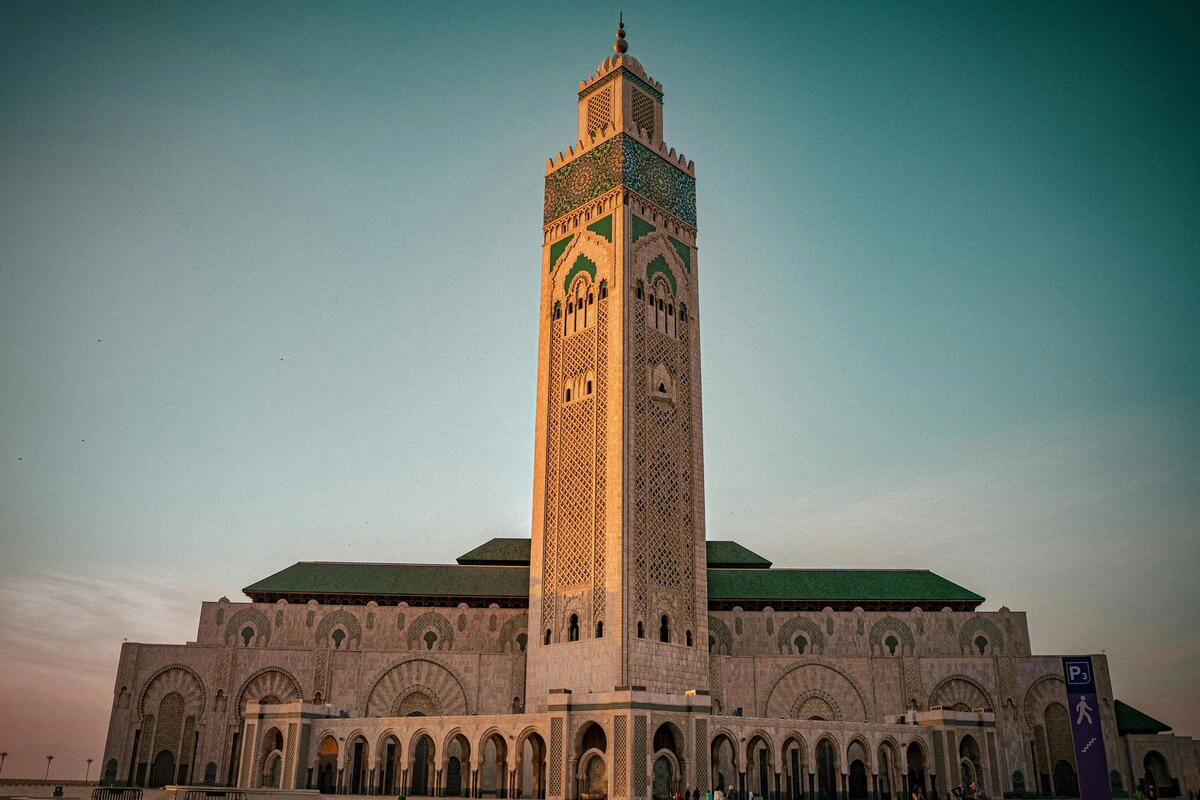
Moroccan churches clearly show the unique Arab-Andalusian style of architecture that comes from the larger Islamic culture. Because of their designs, Arabic calligraphy is now an art form that moves people deeply before it even looks good. They also have beautiful arches, tall minarets, and other unique architectural features that make them massive works of art that are still studied in colleges today. Muslims feel a mix of reverence and peace when they visit these churches. They are also proud of the history of Islamic culture. At the same time, they serve as an open gateway to discovering Moroccan and Andalusian heritage, which makes visiting them an experience of both spiritual and cultural importance. Among the most remarkable of these mosques are the Hassan II Mosque and the Koutoubia Mosque.
Hassan II Mosque:
The Hassan II Mosque in Casablanca is the largest mosque in Morocco and the second largest in Africa. Its beautifully decorated minaret is the second-tallest in the world. Commissioned by King Hassan II, the mosque was built by Moroccan artisans and engineers from across the country. Uniquely positioned between land and the clear blue sea, the structure blends with the waves to create a breathtaking visual scene, making it the first Islamic structure to be built over the ocean.
Koutoubia Mosque:
The Koutoubia Mosque is the largest mosque in Marrakech. It was first built in 1147 on the ruins of the Almoravid Ksar al-Hajar palace, the remains of which were later uncovered through archaeological excavations. A second mosque was constructed in 1158. Throughout history, it has stood as a witness to major events in the country, including the French colonial period, during which it was burned, as well as partial damage caused by the earthquake that struck the city in 2023. Between these events, it has remained a timeless symbol of Marrakech and its people.
The mosque was named Koutoubia after the nearby book market that once surrounded it, where more than one hundred booksellers gathered. Its unique architecture is deeply rooted in Arab culture and Islamic design. The mosque features eleven wooden domes and a minaret that rises to a height of 67 meters and 50 centimeters, making it the tallest structure in the city for centuries. Because of its prominence, the minaret is often referred to as the finger of Marrakech, pointing proudly toward the sky.
How Do Zawiyas and Shrines Foster Inner Tranquility?
Zawiyas and institutions of learning built upon the Ash‘ari theology, the Maliki school of thought, and following the path of Imam Junayd al-Baghdadi are among the most important religious and spiritual constants that shape Moroccan identity. Zawiyas, which are religious and educational institutions devoted to the purification and spiritual refinement of the soul, were established and supported by Moroccan rulers who worked to spread them across the country. The first zawiya was built in Marrakech, followed by institutions such as the Dar al-Diyafa and the Grand Zawiya, among others.
These zawiyas are respected institutions that combine both spiritual and educational roles. Within them, the Qur’an is recited and memorized, and Islamic jurisprudence is taught according to the Maliki school. They also focus on the inner life of individuals, guiding believers toward purifying themselves from sins and adorning their character with noble virtues. In addition to their spiritual mission, zawiyas historically played an important social role in their communities. They provided food for the needy, helped those in hardship, and worked to reconcile disputes among people.
Because of this role, zawiyas have become places that nurture spiritual awareness and strengthen the connection between the individual and the Creator. They focus on the well-being of the soul and the serenity of the environment where spiritual reflection takes place.
How Can Religious Visits Become a Complete Spiritual Experience?
Mosques, other places of worship, universities, and zawiyas are all living memorials that show how great Islamic culture was and how history began in these places. People can get a deep sense of the spirituality of Moroccan towns and start a journey of inner clarity by going to mosques, zawiyas, and the shrines of holy people, praying for them, and going to events that honor them. In the towns of Fez and Marrakech, where spiritual practices are still strong, this feeling is especially strong.
When people visit these places and start to pray in the traditional way, they feel calm and peaceful
.
In the end, the most important thing about a holy trip is not how many places you see or how many pictures you take, but how deeply it affects your soul. If a tourist goes to these places with a pure heart and serious purpose, thinks about what they mean, and remembers the lives of prophets and the righteous, the trip changes from just moving from one place to another into a real spiritual experience that brings inner balance and a deep sense of peace.
When you worship, think, learn about history, and connect with the spiritual energy of a place, you have a full experience that stays with you long after you leave. In this way, a religious visit can be a time of spiritual renewal, a chance to think about oneself, and the start of a longer path toward a closer connection with God.