

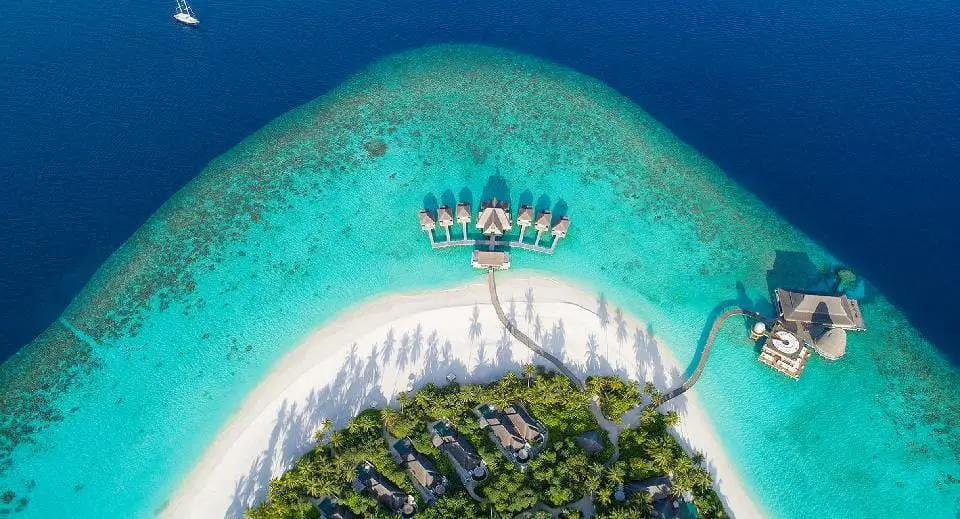
The Maldives does not begin with spectacle. It begins with stillness. Even before the speedboat reaches your island, there is a soft recalibration that takes place, the horizon widens, the air lightens, and time loosens its grip. But to experience the Maldives well, one must look beyond the familiar image of floating breakfasts and overwater villas. The country’s beauty is not only in its waters, but in the atmosphere it creates: privacy without excess, elegance without noise, and a rhythm of life that invites you to exhale more deeply than usual. Maldives is also described the destination as especially suited to Muslim travelers, noting that halal food, prayer facilities, and Islamic cultural sites form part of the experience across local communities.
Begin, if you can, in Malé rather than bypassing it. The capital is where the Maldives reveals its cultural spine. At Hukuru Miskiy, the Old Friday Mosque, you encounter one of the country’s most important Islamic monuments, built in 1658 from interlocking coral stone, with intricate carvings, lacquer work, and a historic minaret beside it. This is not the polished grandeur of imperial capitals; it is something rarer and more intimate: craftsmanship shaped by island faith, salt air, and centuries of devotion. Stay a little longer than most visitors do. Notice the carved tombstones nearby, the texture of the coral walls, and the sense that the Maldives has always been more than a honeymoon image.
From there, walk through the compact historic core of Malé. Pass by Muleeaage, the official presidential residence, whose story links the islands’ royal past with the modern republic. Continue toward Sultan Park, a small green oasis in the city, the kind of pause that matters in a dense capital. Nearby, the National Museum adds another layer to the journey, offering an encounter with the Maldives not as a resort postcard, but as an old seafaring civilization shaped by trade, monarchy, Islam, and island resilience. This part of the country is often overlooked, yet it gives emotional depth to everything that follows.
Then let the Maldives return you to its marine world, but do so with intention. In Baa Atoll Biosphere Reserve, the country’s ecological splendor takes on a more meaningful form. This is not simply beautiful water; it is protected beauty. As Hanifaru Bay, within the reserve, has seen some of the largest gatherings of manta rays anywhere in the world, with up to a hundred gathering to feed when plankton-rich tides move through the bay. For the traveler who values rarity, this is one of the Maldives at its most extraordinary: graceful, alive, and still governed by natural rhythm rather than performance.
Elsewhere, South Ari Atoll offers another kind of wonder. The whale sharks there are not a seasonal rumor but a year-round presence in the protected marine area, noted one of the highest re-sighting rates of any whale shark hotspot in the world. To enter these waters is to understand that the Maldives is not defined only by what happens above the surface. Its real luxury also lies beneath it, in clear visibility, reef life, and the privilege of witnessing the ocean on a scale that feels humbling rather than recreational.
Yet some of the Maldives’ most rewarding moments happen on inhabited islands rather than private resorts. Local-island stays and island-hopping are one of the most exciting ways to experience the country, noting that guesthouses offer the same hospitality associated with luxury resorts while allowing travelers to experience day-to-day Maldivian life. This is where the journey softens into something more personal: walking modest village roads lined with palms, hearing the call to prayer drift across the island, eating fresh seafood and traditional dishes without ceremony, and discovering that simplicity here is not lesser than luxury, it is often its most authentic form.
The Maldives also rewards slowness. A dhoni ride between islands, an unhurried afternoon beneath palms, a sunrise over still water before anyone else is awake, these are not empty moments, they are the essence of the place. There is refinement here, certainly, but it is best appreciated when it remains aligned with the environment: privacy that feels respectful, design that does not compete with the sea, and service that knows when to step back. That is why the Maldives suits the Sakina traveler so well. It offers beauty, but also calm. It offers luxury, but also cultural comfort. And for Muslim travelers especially, it offers the uncommon pleasure of feeling both hosted and understood.
Return, finally, to the water at the quieter hour, just before sunset, when the sky pales into silver-gold and the ocean looks almost brushed into place. The Maldives is not only a destination for escape. At its best, it is a destination for restoration. Not because it overwhelms you, but because it gently removes what is unnecessary. What remains is light, sea, prayer, craft, and the rare feeling that tranquility itself can be a form of luxury.
Attractions & Experiences:
Hukuru Miskiy - Old Friday Mosque
Hukuru Miskiy Minaret
Muleeaage, the official presidential residence
Sultan Park
National Museum, Malé
Malé heritage walk through the historic core
Baa Atoll Biosphere Reserve
Hanifaru Bay manta experience
South Ari Atoll whale shark experience
Local island guesthouse stay
Inter-island dhoni or ferry journey
Guided island-hopping across inhabited islands

